
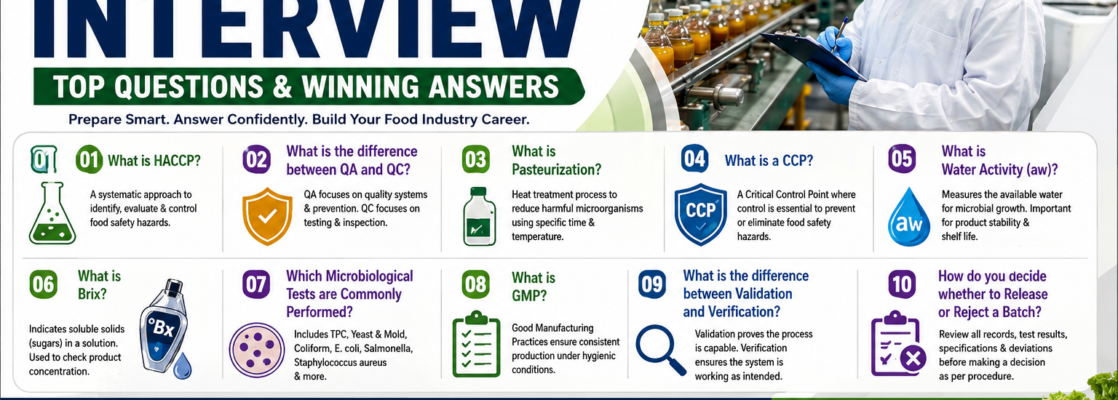
Getting ready for a Food Industry QA, QC, Food Safety, or Food Technologist interview? Technical knowledge can make a big difference when the interviewer starts asking practical questions.
Candidates are often asked about HACCP, quality assurance, critical control points, microbiological testing, GMP, product specifications, and the difference between validation and verification. These questions are designed to see whether you understand how food-quality principles are applied in real production environments.
In this guide, JobzHub brings together 10 important food-sector interview questions with simple explanations to help fresh graduates and experienced professionals prepare with confidence.
1. What Is HACCP?
HACCP stands for Hazard Analysis and Critical Control Points.
It is a preventive food-safety approach used to identify potential biological, chemical, and physical hazards and establish controls to keep those hazards within acceptable limits.
Instead of waiting until a finished product fails inspection, HACCP focuses on controlling risks during the production process.
Interview tip
Don’t simply memorize the full form. Explain that HACCP is preventive, risk-based, and focused on controlling significant food-safety hazards.
2. What Is the Difference Between QA and QC?
This is one of the most common questions for food-industry candidates.
Quality Assurance (QA) focuses on the systems and processes used to consistently produce safe and acceptable products.
Quality Control (QC) focuses more directly on inspection, testing, sampling, and checking whether a product meets established requirements.
A simple way to remember it is:
QA = preventing quality problems through systems
QC = detecting problems through inspection and testing
In an interview, give a practical example. For instance, an established sanitation procedure can be part of QA, while testing a finished product against specifications is a QC activity.
3. What Is Pasteurization?
Pasteurization is a controlled heat-treatment process used to reduce harmful microorganisms in certain foods and beverages.
The treatment is performed using a defined combination of temperature and time appropriate to the product.
The objective is to improve microbiological safety while maintaining the desired characteristics of the product.
Interview tip
If asked about pasteurization, avoid giving a random temperature unless you know the specific product and process. The required conditions vary depending on the food, process, and applicable requirements.
4. What Is a CCP?
CCP means Critical Control Point.
A CCP is a step in a food process where control is essential for preventing, eliminating, or reducing a significant food-safety hazard to an acceptable level.
For example, a validated heat-treatment step may be identified as a critical control point when it is necessary to control a particular microbiological hazard.
The important part of your answer is to show that a CCP isn’t simply another quality check. It is connected specifically to food-safety hazard control.
HACCP-based interview discussions commonly test candidates on CCP identification, monitoring, and corrective action. (LinkedIn)
5. What Is Water Activity (aw)?
Water activity, commonly written as aw, describes how much water in a food is available to support biological and chemical activity.
It is different from simply measuring the total amount of moisture in a product.
Water activity is important because microorganisms require available water to grow. Controlling aw can therefore contribute to product stability and food safety.
For a QA/QC interview, explain that aw can be important when assessing:
- Microbial growth potential
- Product stability
- Shelf life
- Formulation
- Storage conditions
A strong candidate should understand that moisture content and water activity are related but not identical measurements.
6. What Is Brix?
Brix is commonly used to express the concentration of soluble solids in products such as fruit juices, beverages, syrups, and similar foods.
In many applications, Brix measurement is particularly associated with the amount of soluble solids, with sugars being a major contributor.
A Brix measurement can help a production or quality team check whether a product is within its expected formulation or specification.
Example
If a beverage specification requires a particular Brix range, QC personnel can measure the product and compare the result with the approved specification.
7. Which Microbiological Tests Are Commonly Performed in Food?
The exact microbiological tests depend on the product, process, risk assessment, and applicable standards.
Depending on the food category, laboratories may test for organisms or indicators such as:
- Total Plate Count
- Yeasts and molds
- Coliforms
- E. coli
- Salmonella
- Staphylococcus aureus
- Other relevant pathogens or indicator organisms
Don’t simply list microorganisms in an interview. Explain why testing is performed and how the results relate to product safety, hygiene, process control, or specifications.
Food QA/QC interview material commonly includes microbiological testing alongside GMP, HACCP, sampling, and product-release questions. (LinkedIn)
8. What Is GMP?
GMP stands for Good Manufacturing Practices.
GMP provides practical requirements and controls that help ensure products are manufactured consistently under appropriate hygienic and controlled conditions.
In a food facility, GMP can involve areas such as:
- Personal hygiene
- Cleaning and sanitation
- Facility conditions
- Equipment
- Pest control
- Raw-material handling
- Storage
- Production practices
- Documentation
A good interview answer should connect GMP with everyday activities rather than treating it as only a theoretical concept.
9. What Is the Difference Between Validation and Verification?
This question can catch candidates who have memorized terminology without understanding the difference.
Validation provides evidence that a process or control is capable of achieving its intended result.
Verification checks whether the established system or control is actually being followed and remains effective.
A simple way to remember it:
Validation asks: “Will this control work?”
Verification asks: “Are we doing what we established, and is the system being maintained?”
Both concepts are important within food-safety and quality-management systems. Interview resources for food-industry roles regularly distinguish validation from verification. (RoleCatcher)
10. How Do You Decide Whether to Release or Reject a Batch?
This is a practical question, so your answer should demonstrate a systematic approach.
Before releasing a batch, the responsible quality team may review applicable:
- Raw-material records
- Production records
- In-process checks
- Finished-product test results
- Microbiological results where applicable
- Packaging and labeling requirements
- Process deviations
- Quality documentation
- Product specifications
If the required evidence demonstrates that the batch meets approved specifications and release requirements, it can be considered for release by the authorized person.
If there is a significant deviation or the product fails an applicable requirement, the batch should not simply be released because production is complete. The issue needs to be investigated and handled according to the organization’s quality system.
Interview tip
Don’t answer with only “I would release it if the product looks fine.”
Quality decisions should be based on documented requirements, test results, specifications, deviations, and authorized procedures.
How to Prepare for a Food QA/QC Interview
Knowing definitions is only the first step.
Interviewers may ask you to explain how you would respond to an actual situation. For example:
What would you do if a finished product fails a specification?
A strong answer could include:
- Identify and document the deviation.
- Hold or segregate the affected product when required.
- Review relevant production and QC records.
- Investigate the possible root cause.
- Assess the impact on other batches or products.
- Establish appropriate corrective action.
- Verify that the corrective action was effective.
- Make the final disposition according to the approved quality procedure.
This demonstrates practical thinking instead of simply repeating textbook definitions.
Important Topics to Revise Before Your Interview
If you’re applying for a Food Technologist, QA Officer, QC Officer, Food Safety Officer, or Quality Executive position, revise these areas before the interview:
Food Safety
Understand HACCP, hazards, CCPs, prerequisite programs, hygiene, sanitation, and contamination prevention.
Quality Control
Revise sampling, specifications, laboratory testing, calibration, non-conformities, and product release.
Quality Assurance
Understand SOPs, documentation, audits, corrective actions, verification, and continuous improvement.
Food Microbiology
Know the purpose of common microbiological tests and understand how contamination can occur.
Food Processing
Review concepts such as pasteurization, thermal processing, cold-chain control, water activity, and product stability.
Food Standards
Be familiar with major food-safety management concepts such as HACCP and ISO 22000. HACCP and ISO 22000 are frequently discussed together in food-industry interview preparation because HACCP provides the hazard-control methodology while ISO 22000 places food-safety controls within a broader management-system framework. (LinkedIn)
How Fresh Graduates Can Answer Technical Questions
If you are a fresh graduate, don’t panic if you don’t have years of factory experience.
Instead of pretending that you have performed a task professionally, explain the correct principle and, where appropriate, connect it to your university projects, laboratory work, internship, or training.
For example:
“During my academic training, I learned how HACCP is used to identify hazards and establish controls. If I encountered a deviation in a production environment, I would follow the company’s documented procedure, inform the responsible quality personnel, and support the investigation.”
That sounds much stronger than trying to invent professional experience.
Common Mistakes Candidates Make
Memorizing Without Understanding
Interviewers can usually tell when a candidate has memorized definitions but cannot explain their practical meaning.
Giving Extremely Long Answers
Start with a clear answer and then provide an example if the interviewer wants more detail.
Ignoring Documentation
Food quality isn’t only about laboratory testing. Records, procedures, traceability, corrective actions, and verification are also important.
Confusing Food Safety With Food Quality
Food safety focuses on hazards that can make food unsafe, while quality covers broader characteristics and requirements such as composition, sensory properties, consistency, and specifications.
Not Using Practical Examples
Whenever possible, explain how a concept would work on an actual production floor.
Final Words
A successful food-industry interview requires more than knowing the definitions of HACCP, GMP, QA, and QC.
You should be able to explain how quality and food-safety principles are applied in real situations.
Spend time revising the fundamentals, but also practice answering scenario-based questions. Think about what you would do if a product failed a specification, a critical limit was exceeded, a microbiological result was unacceptable, or a hygiene problem was discovered.
Most importantly, answer honestly. If you are a fresh graduate, show your knowledge and willingness to learn rather than claiming experience you don’t have.
For candidates preparing for their next Food QA/QC interview, these 10 questions are a strong starting point.
Reference Links
- Food QA/QC interview preparation reference
- Food Technologist interview topics: HACCP, ISO 22000 and BRCGS
- Food and Beverage Packaging Technologist interview guide
- Food Scientist interview questions and QA topics
More Recent Jobs & Career Posts on JobzHub
For internal linking on your website, I recommend connecting this article with OUR recent related posts.
Visit JobzHub.online for more jobs and career updates
Disclaimer: Interview questions vary by company and position. Candidates should use this guide for preparation rather than assuming every employer will ask the same questions.